High-Volume Batch Processing
Parallelized Web Worker threads prevent UI main-thread blocking during 100+ image compression tasks.
Engineering Case Study
Privacy-first image compression, powered entirely by your device.
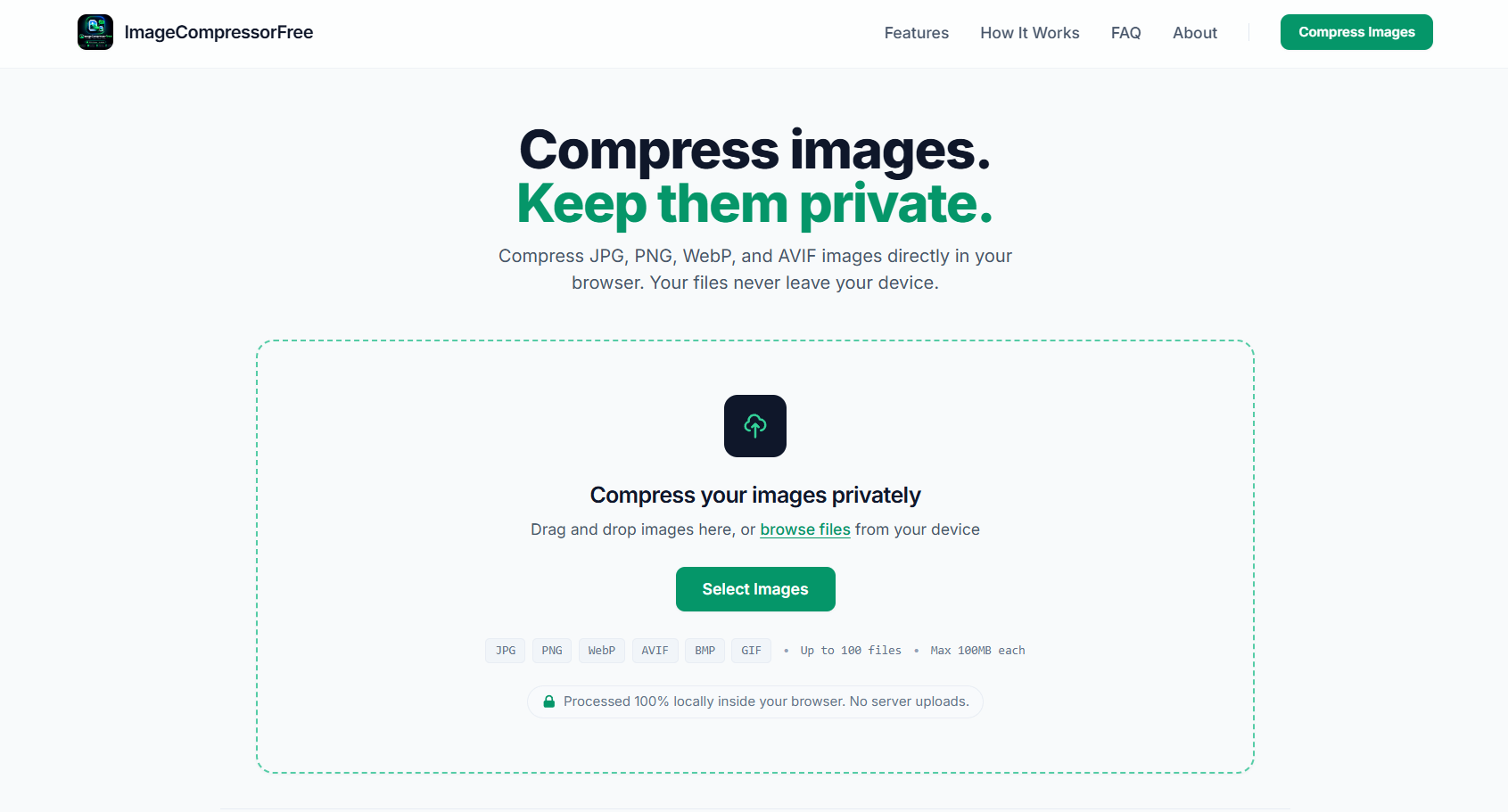
Every day, millions of images are uploaded to online compression tools before they're shared, published, or deployed.
It's a workflow most people never question.
The process works. But it quietly asks users to trade privacy, speed and control for convenience. I believed there was a better way.
“Why should image compression require someone else's server at all?”
Modern web browsers are incredibly powerful computation engines. Instead of transmitting files across the internet, why not perform image processing directly inside the user's browser?
The goal became simple: Move computation to the user's device. Remove the backend server completely.
Instead of sending images to a remote server, process them locally using client-side WebAssembly and modern Canvas APIs.
“Why should image compression require someone else's server at all?”
Zero uploads. Zero servers. Instant output.
Files stay strictly in browser memory. No data ever leaves your device.
Eliminates network latency. Compression runs as fast as local CPU/GPU allows.
Compress dozens of high-res images simultaneously without queue limits.
No backend compute infrastructure required, making it free forever.
Privacy isn't a feature. It's part of the architecture.
Building for scale inside the DOM.
Parallelized Web Worker threads prevent UI main-thread blocking during 100+ image compression tasks.
Memory-managed canvas buffers prevent mobile browser tab crashes on high-res camera RAW/PNG files.
Entire app bundle is statically served and works offline after initial page load via ServiceWorker caching.
Tested across Chromium, WebKit, and Gecko engines to guarantee consistent output quality and aspect ratios.
This project demonstrates more than image compression—it demonstrates first-principles product thinking.
Questioning whether centralized infrastructure is necessary or simply default habit.
Leveraging client hardware capabilities to eliminate unnecessary network hops.
Removing account creation, paywalls, and waiting states from core user workflows.
Eliminating data collection entirely by never receiving user files in the first place.
This project demonstrates how I approach software engineering and product development.
I don't start with technology trends or complex infrastructure for the sake of it. I start by questioning assumptions, then build systems that are simpler, faster, private, and reliable—built strictly around user outcomes.
“Software shouldn't be impressive because it's complex. It should be impressive because it makes difficult problems feel effortless.”
For the browser constraints and measurement questions behind this product, read the engineering note