The constraint moves with the computation
ImageCompressorFree starts with a simple product decision: the user selects an image, but the compression job is intended to run on that user’s device. The live product describes local processing, a browser-based before/after inspector, individual downloads, and ZIP export. The case study explains why avoiding an upload was central to the design.
That changes the engineering problem. A server-side tool can allocate memory and schedule jobs centrally. A browser tool must work inside the limits of a particular tab, device, and browser. Keeping file bytes out of an application upload path is a meaningful privacy property; it is not a claim that the website makes no network requests for its own code or assets.
Evidence boundary: the product interface and case study are available here, but the compression engine’s source and repeatable benchmark fixtures were not available for this writeup. Implementation details not established by those sources are treated as open questions.
From selection to a usable result
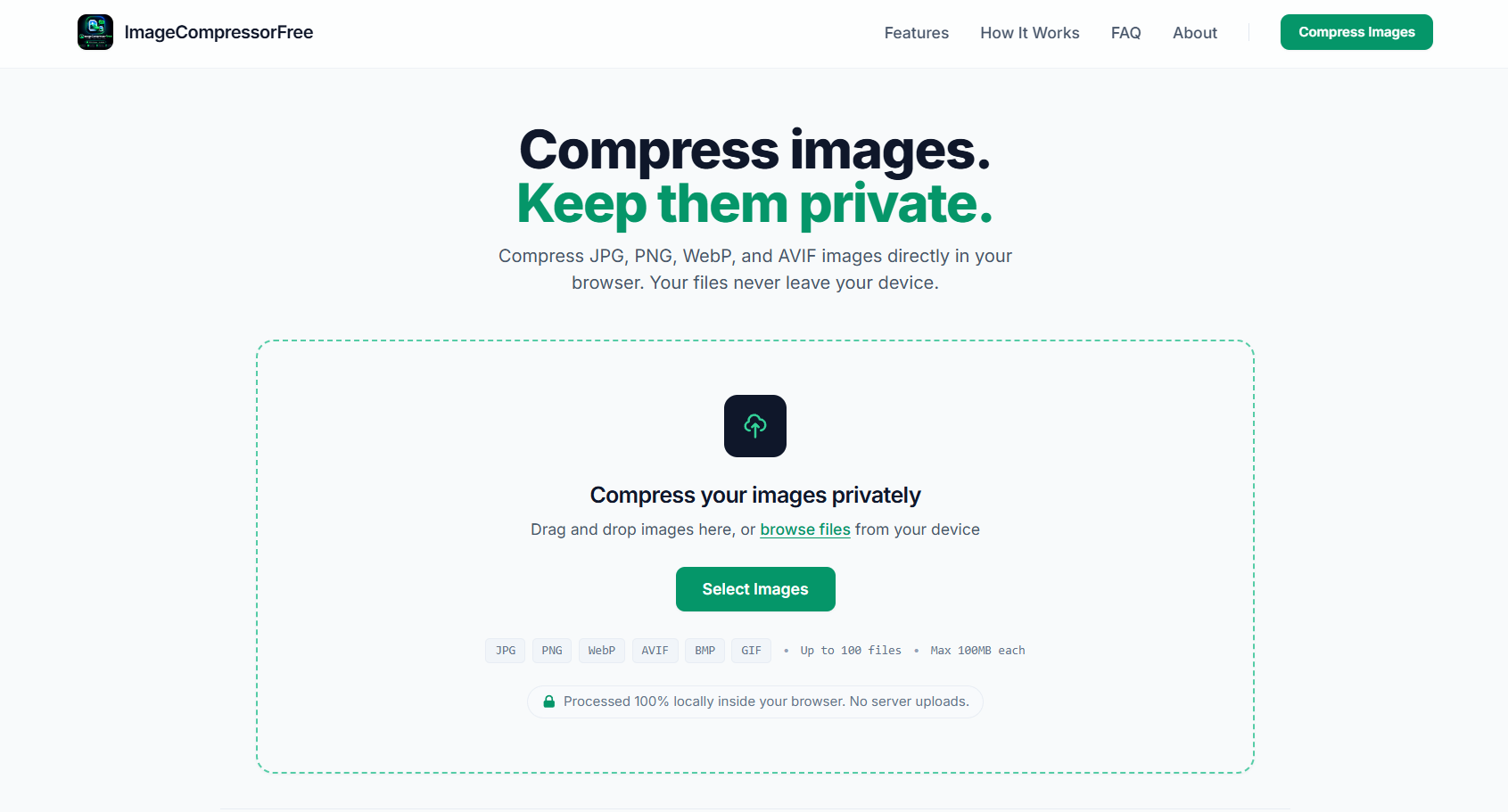
The public workflow accepts a file picker or drag-and-drop input. Browsers expose those selected items as File objects; a local selection does not itself require an upload. The product advertises JPEG, PNG, WebP, AVIF, BMP, and GIF input, with a user-facing limit of 100 files and 100 MB per file. Those are product limits, not a claim that every such batch will succeed on every phone.
The product documentation says it uses parallel Web Workers. That is a sensible boundary for CPU-heavy work: workers run separately from the page’s main thread, so processing can avoid monopolizing input and rendering. It does not make memory free. Each decoded bitmap, intermediate representation, preview, and output may coexist for part of a batch. The actual scheduling and buffer-release strategy would need source inspection or profiling before I could describe it as a measured implementation fact.
Formats and quality are not one number
“Compression” can mean changing a format, changing quality, resizing dimensions, removing metadata, or several of those at once. These operations answer different user needs. A transparent graphic, a photographic JPEG, and an animated image should not be judged by the same byte-saving target. Browser encoding support also varies: for example, the standard canvas toBlob API guarantees PNG export and may support other types; an unsupported requested type falls back to PNG.
The product offers manual and smart quality controls, but a single “up to” reduction is not an engineering result without its input image, output format, dimensions, visual-quality measure, and device. I leave out percentage claims until the input files and test method are reproducible.
Privacy is the starting constraint. Output quality, memory use, and failure behavior decide whether the local workflow is actually useful.
What I would measure next
A useful benchmark would keep a small, public fixture set: a photograph, a high-detail screenshot, a transparent graphic, and an already-compressed source. For each run I would record source bytes and dimensions, chosen output format and settings, resulting bytes, elapsed processing time, visual comparison, browser, device, and whether the export decoded correctly. A quality score such as SSIM could supplement visual review, but would not replace it.
Batch testing should separately record peak memory and failure behavior on lower-memory devices. A documented 100 MB file limit is an input validation rule; it is not proof that decoding a 100 MB image has a 100 MB memory footprint. The next source-level review should also verify how worker jobs are bounded, cancelled, and cleaned up, and whether unsupported codecs are reported clearly instead of silently changing format.
The most transferable design lesson is narrower than “browser compression is always faster.” Moving the data path local removes a file-upload step and gives the product a clearer privacy boundary. The rest—speed, output quality, compatibility, and reliability—still has to be measured under named conditions.
Sources and scope
- ImageCompressorFree product and the existing engineering case study for the documented workflow.
- MDN File API guide for user-selected local files.
- MDN Web Workers guide and canvas export reference for the browser constraints discussed above.